
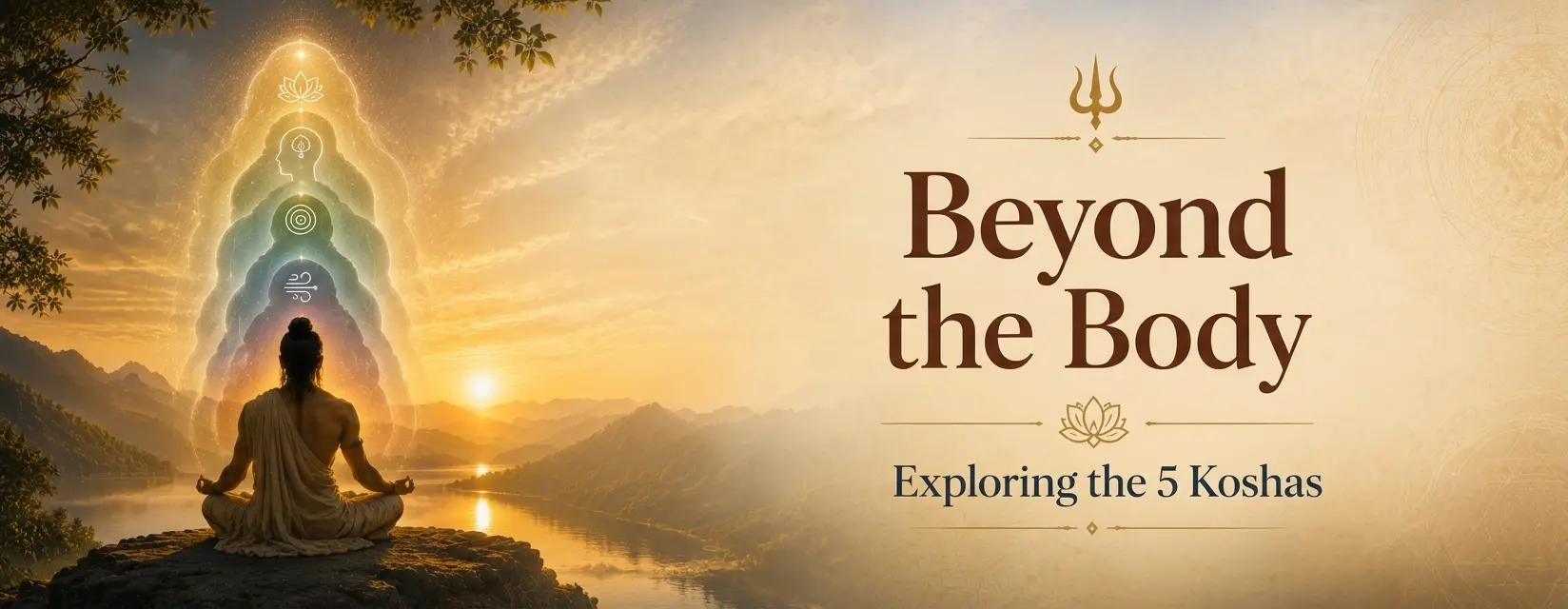
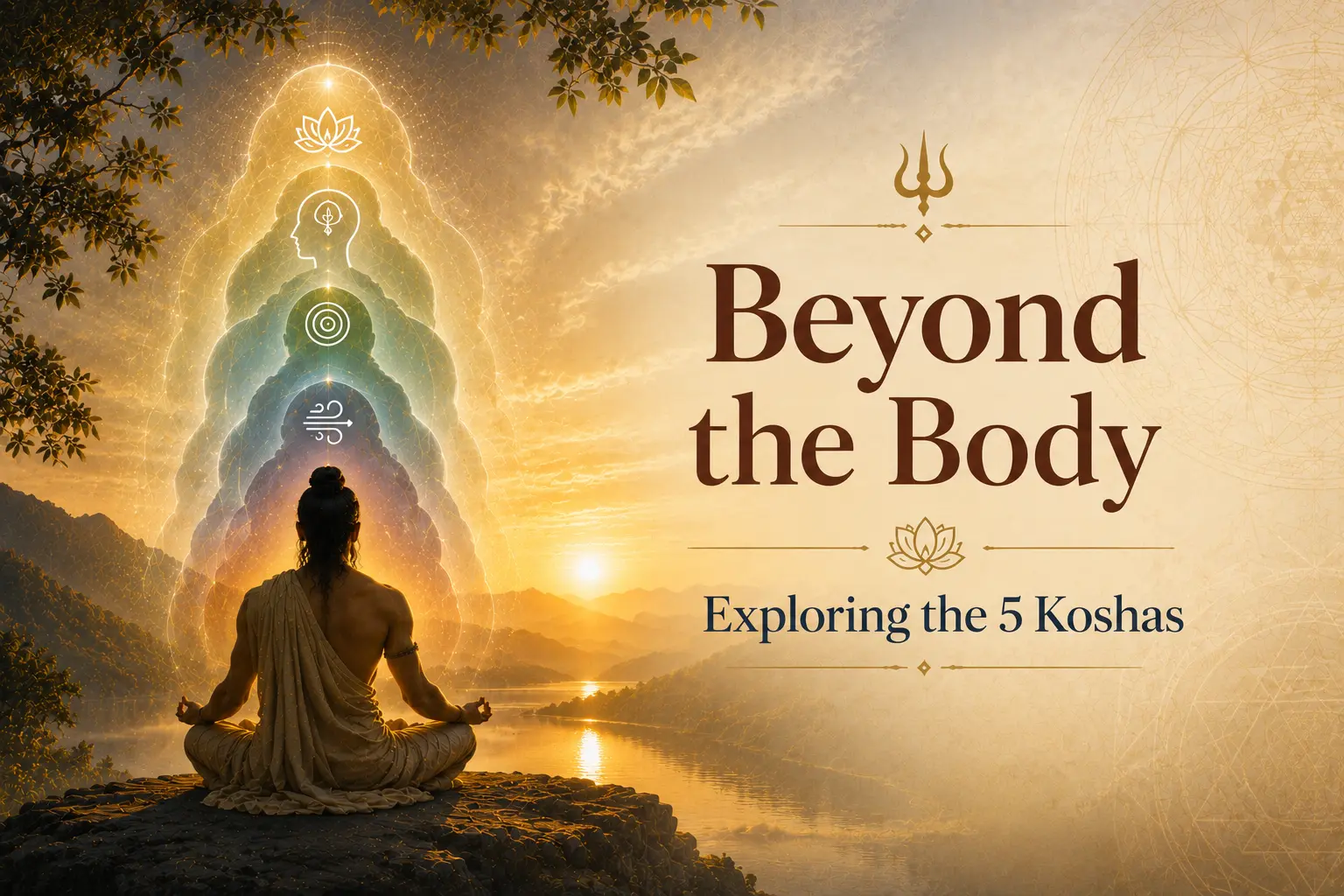
Beyond the Body
The teaching of the five kośas comes primarily from the Taittirīya Upaniṣad, not from Trika Shaivism directly.
This distinction is important.
In Vedānta, the five kośas are presented as five sheaths or layers through which the seeker investigates the apparent self and gradually recognizes that the true Self is beyond body, energy, mind, intellect, and even bliss.
In Trika Kashmir Shaivism, the primary maps are different. Trika speaks of Citi, Śiva-Śakti, 36 tattvas, malas, kañcukas, upāyas, spanda, and pratyabhijñā. Yet the five kośas can still be understood beautifully through the Trika lens, if we do not force them into the tradition artificially.
From a Trika perspective, the kośas are not merely coverings to be rejected. They can be seen as layers of contracted Śakti — expressions of consciousness appearing as body, prāṇa, mind, intelligence, and bliss.
The aim is not to hate these layers.
The aim is to recognize the Citi shining through them.
The Five Kośas
The five kośas are traditionally named:
- Annamaya Kośa : The sheath made of food, the physical body
- Prāṇamaya Kośa : The vital sheath, the field of breath and life-force
- Manomaya Kośa : The mental-emotional sheath
- Vijñānamaya Kośa : The sheath of intelligence, discernment, and subtle knowing
- Ānandamaya Kośa : The bliss sheath, the subtle experience of joy and causal rest
In a simple Vedāntic reading, the seeker moves inward from the gross body to subtler layers, recognizing, “I am not merely this body, not merely breath, not merely mind, not merely intellect, not merely bliss-experience.”
Trika agrees that our real nature is not limited to any one layer.
But Trika adds a powerful nuance: these layers are not outside consciousness. They are Citi appearing in different degrees of contraction and manifestation.
A Trika Key: The Individual as Contracted Citi
Kṣemarāja’s Pratyabhijñāhṛdayam gives a profound key:
चितिसङ्कोचात्मा चेतनोऽपि सङ्कुचितविश्वमयः॥
Citisaṅkocātmā cetano’pi saṅkucitaviśvamayaḥ.
A simple rendering is:
“The individual conscious being, whose nature is the contraction of Citi, contains the universe in a contracted form.”
This is central to the Trika view.
The individual is not separate from universal consciousness. The individual is universal consciousness in contraction.
Therefore, the body, breath, mind, intellect, and bliss-experience are not outside Śiva. They are contracted expressions of Śiva-Śakti.
The problem is not that these layers exist.
The problem is misidentification.
When we say, “I am only the body,” bondage begins.
When we say, “I am only my emotions,” bondage deepens.
When we say, “I am my thoughts,” the mind becomes prison.
When we say, “I am my spiritual bliss,” even bliss becomes subtle bondage.
Trika invites us to recognize: all these are appearing in awareness.
Annamaya Kośa: The Body as Śakti
The physical body is the most visible layer.
It is made of food, nourished by earth, water, sunlight, air, and time. It grows, changes, ages, and dissolves.
Some seekers reject the body as unspiritual. Trika does not.
In Trika, the body is Śakti in form. Breath, posture, sensation, mantra vibration, and energy all move through the body. The body is not the final Self, but it is a sacred doorway.
The practice is not body-hatred.
The practice is body-awareness.
Feel the body as an appearance in consciousness. Let the body become a temple, not an identity.
Prāṇamaya Kośa: Breath as Moving Śakti
The prāṇic layer is the field of breath, vitality, movement, and life-force.
When prāṇa is disturbed, the mind becomes restless. When prāṇa becomes refined, meditation deepens.
Through the Trika lens, prāṇa is not merely biological energy. It is Śakti moving through the subtle channels of embodiment.
Breath awareness, mantra with breath, and the pause between inhalation and exhalation can all become doorways into recognition.
The seeker learns: “I am aware of prāṇa. Therefore, I am not limited to prāṇa.”
But one does not reject prāṇa.
One allows prāṇa to return to awareness.
Manomaya Kośa: Mind as Contracted Consciousness
The mental sheath contains thought, emotion, memory, imagination, fear, desire, and inner commentary.
Most suffering happens here.
The mind repeats stories. It creates identities. It divides experience into like and dislike, mine and not mine, success and failure, sacred and ordinary.
Trika does not call the mind an enemy. It says the mind is Citi in contraction.
When the mind moves outward unconsciously, it creates bondage.
When the mind turns inward, it becomes a vehicle of recognition.
Thought is not the problem.
Identification with thought is the problem.
Meditation begins when thought is seen as movement within awareness.
Vijñānamaya Kośa: Intelligence and the Subtle Ego
The sheath of vijñāna is more refined. It includes understanding, discernment, decision, subtle identity, spiritual knowledge, and the sense of “I know.”
This layer is powerful and dangerous.
It can help the seeker discriminate between truth and confusion. But it can also create spiritual pride.
A person may know Sanskrit terms, quote scriptures, understand tattvas, and still remain bound by the subtle ego of knowledge.
In Trika, true wisdom is not merely conceptual understanding. It is recognition.
Knowledge becomes liberating only when it turns the knower back toward the source of knowing.
Otherwise, even philosophy becomes another sheath.
Ānandamaya Kośa: Bliss Is Not the Final Self
The bliss sheath is very subtle.
In meditation, devotion, mantra, or deep rest, the seeker may experience peace, joy, expansion, or sweetness. These are precious states, but Trika warns us not to mistake experience for the Self.
Bliss comes and goes.
The awareness that knows bliss does not come and go.
This distinction is essential.
In Trika, ānanda is indeed a power of consciousness. But a passing bliss-experience is not yet stable recognition. The seeker must go beyond attachment to meditative pleasure and recognize the consciousness in which bliss appears.
Even bliss must be offered into Śiva.
Beyond the Kośas: Recognition
The five kośas can become a beautiful contemplative map.
Begin with the body.
Feel it.
Then notice breath.
Then notice mind.
Then notice intelligence.
Then notice subtle bliss or peace.
Now ask:
What is aware of all these?
That awareness is not another sheath.
It is the light in which all sheaths appear.
Through the Trika lens, the journey is not merely from outer to inner. It is from misidentification to recognition.
The body is Śakti.
The breath is Śakti.
The mind is Śakti.
The intellect is Śakti.
Bliss is Śakti.
But the essence of all is Citi — free, luminous, self-aware consciousness.
A Simple Practice
Sit quietly.
Feel the body: “This body is known.”
Feel the breath: “This prāṇa is known.”
Observe thoughts and emotions: “This mind is known.”
Notice understanding: “This intelligence is known.”
Feel peace or bliss if present: “This too is known.”
Now rest in the knower.
Do not try to imagine anything.
Simply recognize the awareness in which all layers appear.
This is the Trika way of moving beyond the body without rejecting the body.
Conclusion: Nothing Is Outside Śiva
The five kośas help us understand the layered nature of human experience.
The physical body, prāṇa, mind, intelligence, and bliss are all important. But none of them alone is the ultimate Self.
Through Vedānta, the kośas are examined and transcended.
Through Trika, they are recognized as expressions of Śakti and returned to their source in Citi.
This is the beauty of the non-dual Shaiva view.
Nothing has to be hated.
Nothing has to be violently rejected.
But nothing should be mistaken for the whole truth.
The body is sacred, but you are more than the body.
Breath is sacred, but you are more than breath.
Mind is sacred, but you are more than mind.
Knowledge is sacred, but you are more than knowledge.
Bliss is sacred, but you are more than bliss.
You are the awareness in which all these arise.
And in the language of Trika, that awareness is none other than Śiva-consciousness, shining through every layer of your being
Explore the Layers of Consciousness
Discover more teachings on body, breath, mind, Śakti, meditation, tattvas, and non-dual Kashmir Shaivism at Trika.in.