
Get a special discount for new members!

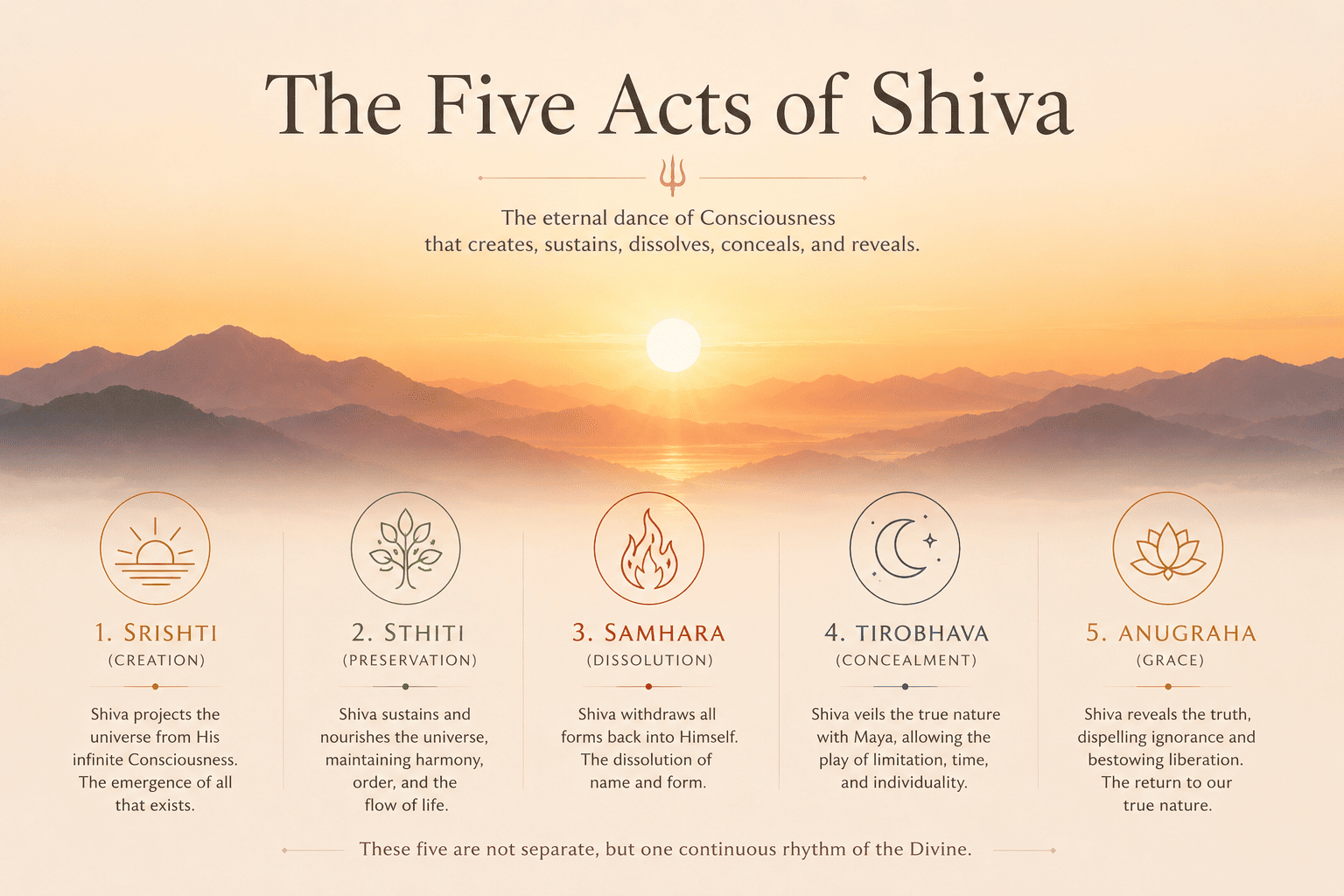
In Trika Tantra, Shiva is not understood as a passive, distant, inactive Absolute.
Shiva is pure consciousness, but this consciousness is alive. It shines, knows, creates, sustains, withdraws, conceals, and reveals. In Kashmir Shaivism, the Supreme is not merely a witness standing outside the universe. The universe itself is the living play of Shiva’s own freedom, svātantrya śakti.
This living activity of Shiva is traditionally described through the five acts, known as pañcakṛtya.
These five acts are:
These are not only cosmic events. They are happening every moment — in the universe, in the mind, in meditation, in relationships, and in spiritual awakening.
The Pratyabhijñāhṛdayam explains that even in the limited condition, the individual soul performs the five functions as the Supreme Self. Its notes identify these five as sṛṣṭi, sthiti, saṃhāra, vilaya, and anugraha — manifestation, maintenance, reabsorption, concealment, and divine grace.
Jaideva Singh’s introduction to the same text explains that, in nondual Shaiva philosophy, Shiva’s activity is summed up in the fivefold act of emanation, maintenance, withdrawal, concealment of real nature, and grace. It also emphasizes that Shiva performs these acts eternally, even when assuming the form of the empirical ego or jīva.
This is a very profound point.
The five acts are not only what God does “out there.” They are also what consciousness is doing within you.
Every thought appears.
That is creation.
The thought remains for a while.
That is preservation.
The thought dissolves.
That is dissolution.
You forget the awareness in which the thought appeared.
That is concealment.
You suddenly recognize awareness again.
That is grace.
In this way, the whole spiritual path can be understood through the five acts of Shiva.
Sṛṣṭi means creation, emanation, or manifestation.
In Trika, creation does not mean that Shiva produces a universe from outside himself. Shiva manifests the universe within his own consciousness, through his own Shakti.
Every perception is a small creation.
A sound appears. A thought appears. A memory appears. A desire appears. A world appears before the senses.
We usually take these appearances as ordinary. But Trika invites us to see them as the shining of consciousness. The universe is not separate from Shiva. It is Shiva appearing as form, sound, breath, mind, body, and world.
Creation is happening now.
The moment experience appears, sṛṣṭi is present.
Sthiti means preservation, maintenance, or continuation.
After something appears, it remains for a time. A thought stays long enough to be noticed. A relationship continues. A body is sustained. A world appears stable. A mood lasts. A practice becomes part of life.
This sustaining power is also Shiva.
Without sthiti, nothing could be experienced clearly. Everything would appear and vanish instantly.
In inner life, sthiti is the power by which attention holds an object, mantra continues, breath flows rhythmically, and identity maintains itself.
For the seeker, sthiti can become sacred when it is consciously used.
To maintain a daily practice is also a form of sthiti.
To remain steady in awareness is spiritual sthiti.
Saṃhāra means dissolution, withdrawal, or reabsorption.
Everything that appears also disappears.
Thoughts dissolve. Emotions dissolve. Days end. Bodies age. Relationships change. Worlds pass through cycles. Even identities that once felt permanent eventually soften and disappear.
In ordinary life, dissolution often feels frightening because ego wants permanence.
But Trika teaches that dissolution is not merely loss. It is return.
The wave returns to the ocean. The thought returns to silence. The breath returns to stillness. The mind returns to awareness.
Meditation teaches us to see saṃhāra directly.
A thought arises, stays briefly, and dissolves. If we observe carefully, we see that nothing is destroyed in the deepest sense. The form dissolves, but awareness remains.
This insight reduces fear.
Dissolution is not the enemy of life. It is one of Shiva’s sacred acts.
Tirobhāva, also called vilaya in some Trika contexts, means concealment, veiling, or obscuration.
This is the mysterious act by which consciousness hides its own true nature from itself.
Because of concealment, the infinite feels finite. Shiva appears as the limited individual. Awareness identifies with body, mind, role, memory, fear, and desire.
The seeker says:
“I am small.”
“I am separate.”
“I am incomplete.”
“I am bound.”
This is not because awareness has truly become limited. It is because awareness has concealed its own fullness.
Christopher Wallis, summarizing Abhinavagupta’s Tantrasāra, notes that the five independent acts include obscuration, and that all five are performed in microcosm by each individual expression of the Lord.
This means concealment is not only cosmic. It is personal.
Whenever you forget your own awareness and become completely lost in thought, concealment has occurred.
But concealment is not the end.
It prepares the ground for grace.
Anugraha means grace, revelation, or the drawing back of the veil.
This is the act by which Shiva reveals himself again.
Grace may come through the Guru, mantra, Shaktipat, meditation, scripture, devotion, suffering, beauty, silence, or sudden recognition.
A seeker may be lost for years in outer life, and then one moment awakens a deep question: “Who am I really?”
That too is grace.
A mantra suddenly becomes alive.
That is grace.
Meditation opens into stillness.
That is grace.
The ego softens, and awareness recognizes itself.
That is grace.
In the Trika view, grace is not separate from Shiva. It is Shiva revealing Shiva.
The same consciousness that concealed itself now recognizes itself.
This is the mystery of the path.
The five acts are happening in every moment.
A mood is created, sustained, dissolved, concealed, and illumined.
A relationship begins, continues, transforms, hides parts of you, and finally becomes a doorway to understanding.
A meditation session begins with thoughts arising, attention stabilizing, distractions dissolving, awareness being forgotten, and then recognition returning.
Even stress follows this pattern.
A stressful thought is created. It is sustained by attention. It dissolves when attention withdraws. Concealment happens when you forget awareness and identify with the thought. Grace happens when you pause and recognize: “This is only appearing in consciousness.”
This makes pañcakṛtya deeply practical.
It is not only a cosmic doctrine.
It is a way to understand your inner life.
The five acts of Shiva reveal that consciousness is dynamic, living, and free.
Shiva creates, preserves, dissolves, conceals, and reveals.
These acts are not only happening in the universe. They are happening in you.
Every thought is born, sustained, and dissolved.
Every identity is formed, maintained, and eventually released.
Every moment of forgetfulness is concealment.
Every moment of recognition is grace.
To understand pañcakṛtya is to begin seeing life differently.
Nothing is outside the movement of Shiva-Shakti.
Creation is sacred.
Preservation is sacred.
Dissolution is sacred.
Even concealment is part of the play.
And grace is always waiting within awareness itself.
The path of Trika is to recognize these five acts not as distant theology, but as the living rhythm of your own consciousness.
Learn more about Shiva, Shakti, the five acts, meditation, mantra, Kundalini, Shaktipat, and Kashmir Shaivism at Trika.in.