
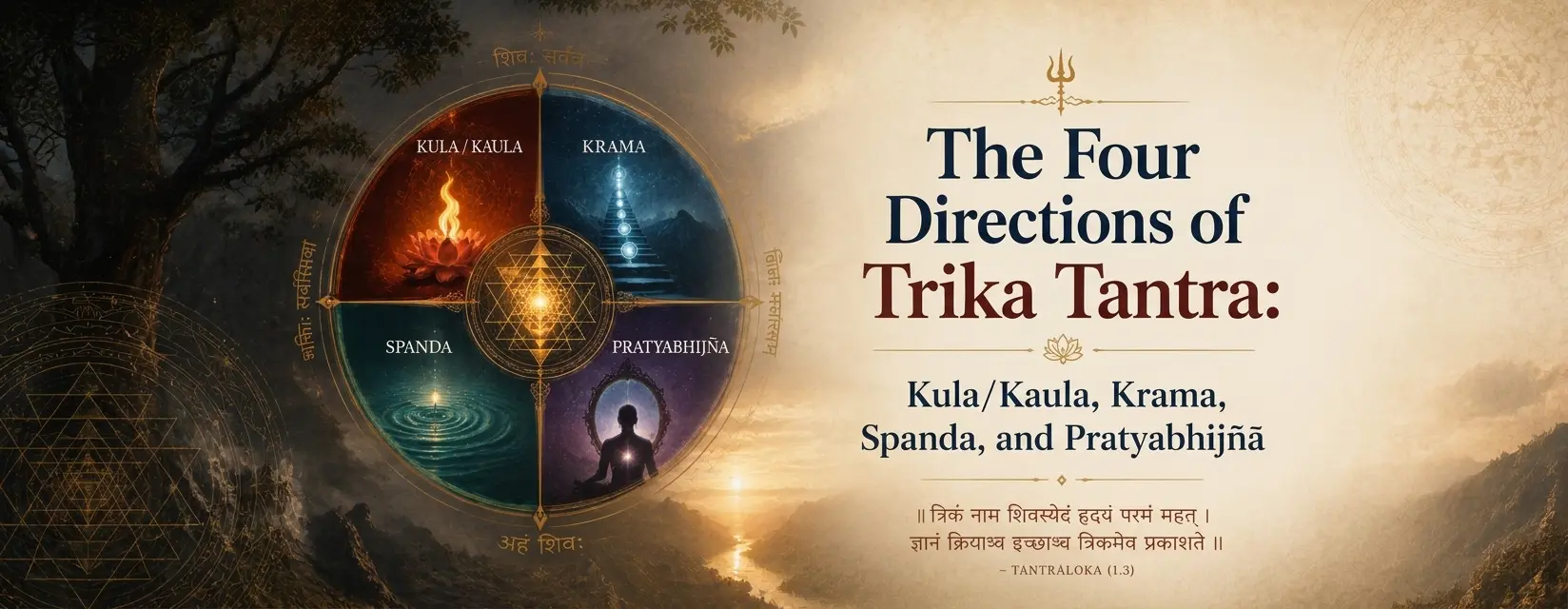
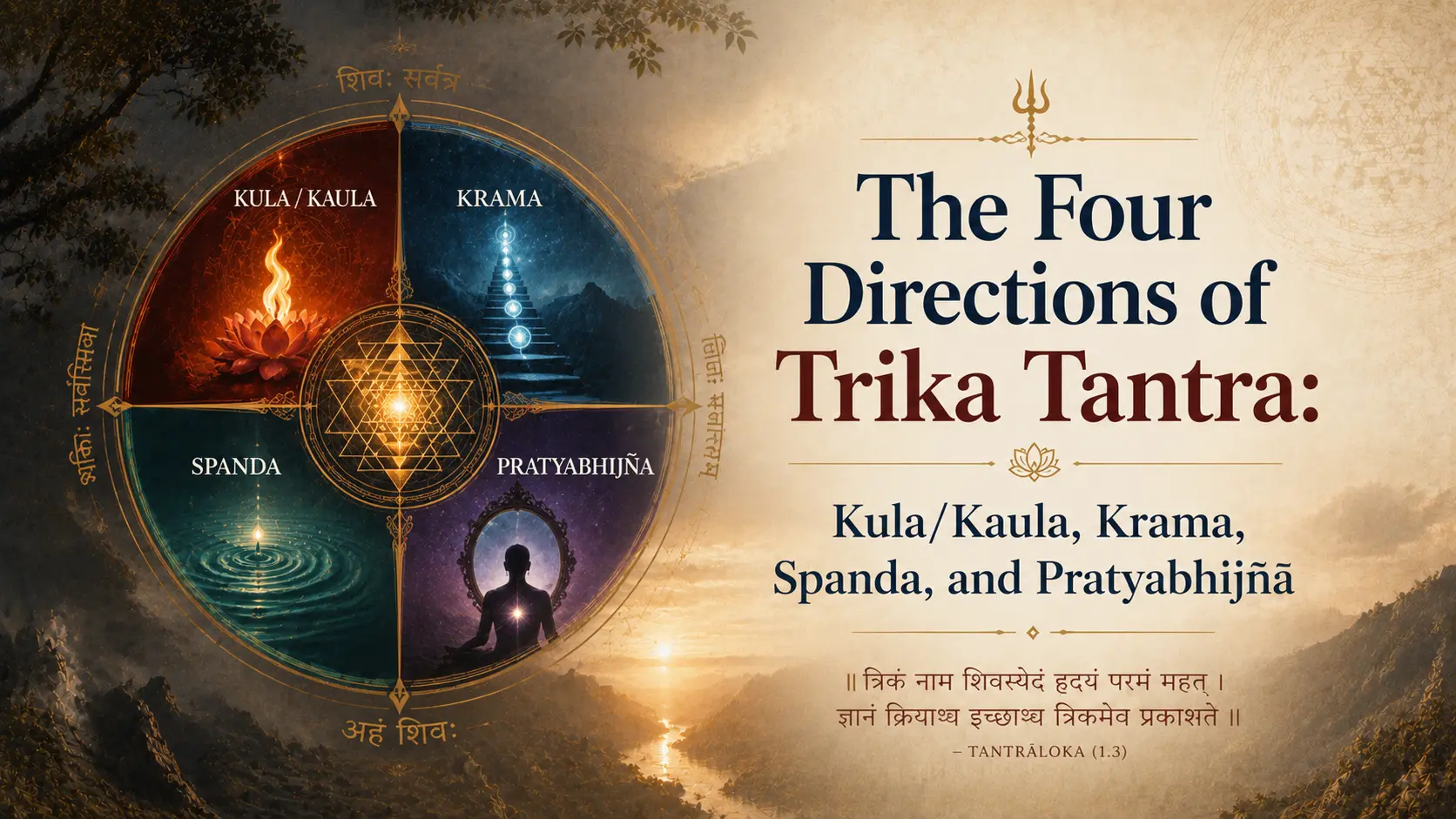
The Four Directions of Trika Tantra
Trika Tantra is not a narrow system.
It is a vast non-dual Śaiva tradition that brings together philosophy, practice, mantra, ritual, meditation, embodiment, recognition, and direct experience. For this reason, it cannot be understood through only one doorway.
Different seekers enter through different temperaments.
Some enter through devotion and the sacred body.
Some enter through the worship of Shakti and the mystery of time.
Some enter through the subtle vibration of awareness.
Some enter through direct recognition of the Self.
This is why the Trika tradition is often explained through four important streams or sub-systems:
Kula / Kaula
Krama
Spanda
Pratyabhijñā
Kula / Kaula: The Path of Totality
The word Kula carries the meaning of family, group, body, totality, or sacred gathering. In Trika understanding, Kula points toward the totality of manifestation — the complete field of Shakti.
Kaula refers to the tradition, practitioner, or mode of realization connected with Kula.
The Kula/Kaula stream is deeply embodied. It does not reject the body, senses, emotions, energy, relationship, ritual, or the world. It sees them as expressions of Shakti.
Where some paths may treat the world as a distraction, the Kaula vision asks: Can you recognize the Divine even here?
- In the body?
- In breath?
- In sensation?
- In desire?
- In ritual?
- In the meeting of Shiva and Shakti?
- The body becomes a temple.
- The senses become doorways.
- The world becomes a mandala.
Krama: The Path of Sacred Sequence
The word Krama means sequence, order, succession, or step-by-step unfolding.
The Krama stream is deeply associated with Shakti, especially the worship and contemplation of Kālī. It gives great importance to the movement of consciousness through stages, moments, phases, and subtle transitions.
If Kula emphasizes totality, Krama emphasizes sequence.
In Krama, awakening is understood through the progressive revelation of consciousness. The seeker observes how perception arises, develops, dissolves, and returns to awareness.
- A thought appears.
- A perception forms.
- A feeling intensifies.
- A moment ends.
- Another begins.
- Behind this flow is Shakti.
Krama is especially sensitive to time, transformation, and inner process. It studies the movement of awareness through the unfolding of experience. This is why it is closely connected to the mystery of time, cognition, and the goddesses of consciousness.
The practitioner learns to see that every moment is born from the previous one and dissolves into the next. But behind all moments is the timeless ground.
Krama teaches that even sequence can become a doorway to the sequence-less.
Time itself can reveal the timeless.
Spanda: The Path of the Sacred Pulse
Spanda means pulsation, throb, vibration, or subtle movement.
But this must not be misunderstood as ordinary physical vibration. Spanda is not merely sound vibration, bodily sensation, or emotional excitement. It is the subtle pulse of consciousness itself — the living dynamism of Shiva-Shakti.
The Spanda stream teaches that consciousness is not dead stillness.
- It is alive.
- Even silence has a pulse.
- Even stillness is vibrant.
- Even the gap between two thoughts is full of living awareness.
In daily life, Spanda can be recognized in breath, attention, emotion, mantra, perception, creativity, and the sudden flash of understanding. Wherever there is life, there is movement. Wherever there is movement, there is Shakti. And wherever Shakti is recognized, Shiva is not far.
The Spanda practitioner does not merely seek blank silence. He learns to recognize the living pulse within all experience.
- A mantra vibrates.
- A thought rises.
- A feeling trembles.
- The heart expands.
- Awareness contracts and expands.
- This subtle movement is not separate from Shiva.
- Spanda teaches that the universe is alive with the pulse of consciousness.
Pratyabhijñā: The Path of Recognition
Pratyabhijñā means recognition.
This is one of the most refined philosophical streams of Kashmir Shaivism. It asks a simple but profound question:
What if liberation is not becoming something new, but recognizing what has always been true?
The individual soul, or jīva, feels limited. It feels separate, incomplete, bound by body, mind, time, karma, and circumstance. But Pratyabhijñā says that this limitation is based on misrecognition.
You are not a small being trying to become Shiva.
You are Shiva who has forgotten your own nature.
The role of the teaching, Guru, scripture, meditation, and grace is to awaken recognition.
Not imagination.
Not belief.
Recognition.
Just as a person may fail to recognize an old friend until someone points him out, the seeker fails to recognize his own Shiva-nature until the teaching reveals it.
The moment recognition dawns, the seeker sees:
“I was searching for the very consciousness by which I was searching.”
This is the brilliance of Pratyabhijñā.
It is direct, philosophical, contemplative, and deeply liberating.
Pratyabhijñā teaches recognition of the Self
How the Four Directions Work Together
These four streams are not enemies.
They complete one another.
Kula says: recognize the totality of Shakti.
Krama says: recognize the sacred unfolding of each moment.
Spanda says: recognize the living pulse within all experience.
Pratyabhijñā says: recognize yourself as Shiva-consciousness.
Together, they form a complete spiritual vision.
Kula gives embodiment.
Krama gives process.
Spanda gives aliveness.
Pratyabhijñā gives direct recognition.
A seeker may be drawn to one stream more than another. A philosophical mind may love Pratyabhijñā. A mantra practitioner may resonate with Spanda. A Śākta-oriented practitioner may feel called to Krama. An embodied Tantric practitioner may naturally enter through Kula/Kaula.
But in mature Trika, these streams are not rigid compartments. Abhinavagupta’s genius was precisely that he could synthesize ritual, philosophy, mantra, aesthetics, yoga, Shakti worship, and direct recognition into a vast non-dual vision.
A Practical Way to Understand Them
For a modern seeker, these four directions can be understood very simply.
When you honor the body, senses, and world as Shakti, you are touching Kula.
When you observe how every experience arises, unfolds, and dissolves, you are touching Krama.
When you feel the subtle pulse of awareness behind thought, breath, mantra, and emotion, you are touching Spanda.
When you recognize that the awareness within you is not separate from Shiva, you are touching Pratyabhijñā.
- This makes the teaching practical.
- It is not only history.
- It is not only doctrine.
- It is a living map for practice.
Conclusion: One Trika, Four Doorways
The four directions of Trika Tantra — Kula/Kaula, Krama, Spanda, and Pratyabhijñā — reveal the richness of Kashmir Shaivism.
- Each stream emphasizes a different face of the same reality.
- Kula reveals totality.
- Krama reveals sequence.
- Spanda reveals the pulse of consciousness.
- Pratyabhijñā reveals direct recognition.
- The body is included.
- Time is included.
- Movement is included.
- Thought is included.
- The world is included.
- And through all of them, the same truth shines:
- Everything is the play of Shiva-Shakti.
Explore the Living Streams of Trika Tantra
Learn more about Kula, Krama, Spanda, Pratyabhijñā, mantra, meditation, Shiva-Shakti, and Kashmir Shaivism at Trika.in.