
Get a special discount for new members!
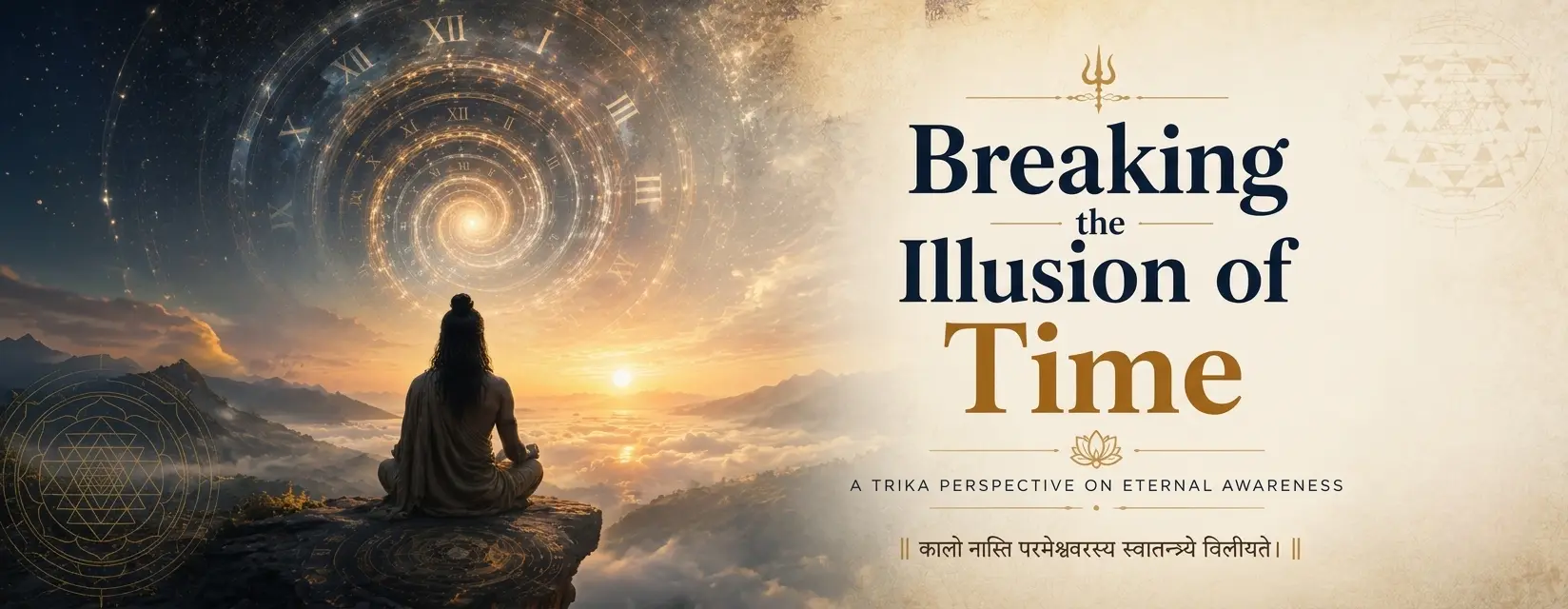
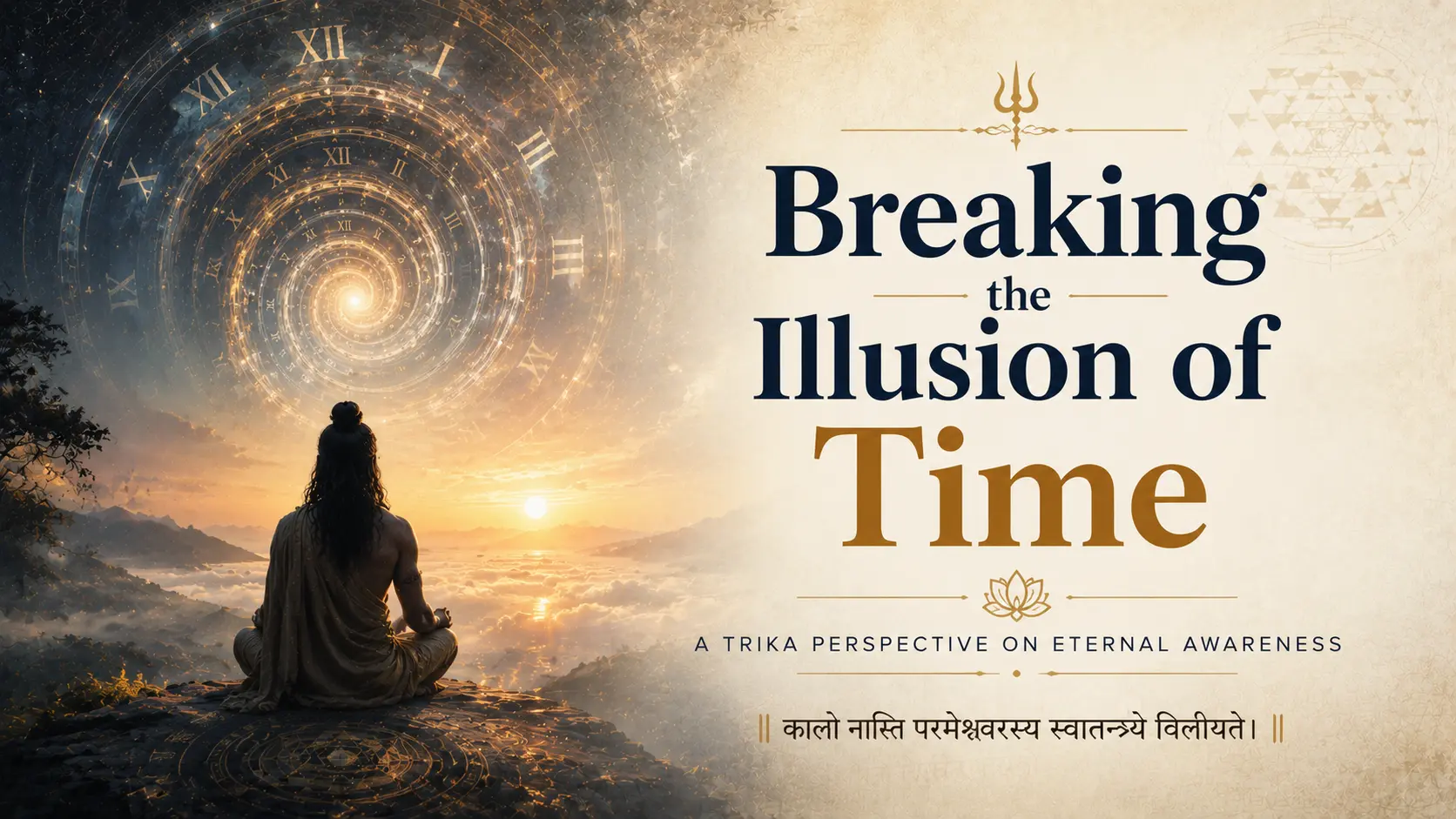
Time feels absolute.
We feel born in time, aging in time, waiting in time, losing in time, hoping in time, and dying in time. The mind constantly moves between past and future. It remembers what happened, regrets what was missed, fears what may come, and imagines a better tomorrow.
Because of this, time seems stronger than us.
But non-dual Kashmir Shaivism gives a radical insight: time is not the ultimate reality. Time is a mode of manifestation within consciousness. It is not outside Shiva. It is not greater than awareness. It is one of the ways infinite consciousness limits itself into the experience of individuality.
To break the illusion of time does not mean denying clocks, seasons, calendars, aging, or practical life. It means seeing that time is not the deepest truth of who we are.
Time belongs to experience.
Awareness is the field in which time appears.
In the Trika system, Kāla is one of the five kañcukas, or limiting coverings, that arise through Māyā. These coverings contract the infinite powers of consciousness into the limited experience of the individual.
Kāla is the limitation of eternity into sequence.
The timeless fullness of Shiva begins to appear as past, present, and future. The eternal “I am” becomes “I was,” “I am now,” and “I will be.” Consciousness, which is intrinsically whole, begins to experience itself as stretched across moments.
This creates the feeling:
“I am growing old.”
“I have lost time.”
“I do not have enough time.”
“My time is running out.”
This is the psychological grip of Kāla.
The problem is not practical time. Practical time helps us live, meet, work, cook, travel, and organize life. The bondage begins when we mistake chronological time for our deepest identity.
Then the timeless Self feels trapped in a timeline.
Kṣemarāja’s Pratyabhijñāhṛdayam gives a beautiful key to this understanding:
A simple rendering is:
This “canvas” is consciousness itself.
The universe, including time, does not appear outside awareness. It unfolds within awareness. Just as an image appears on a screen without being separate from the screen, the entire movement of time appears within Citi, the free power of consciousness.
This changes everything.
If time appears within consciousness, then consciousness cannot be merely inside time.
The body is in time. | The mind is in time. | Memory is in time. | Karma unfolds in time.
But awareness, the light by which time is known, is not itself bound by time.
Much of our suffering is not caused by actual time but by psychological time.
The mind uses memory and imagination to build a prison. The past becomes identity. The future becomes anxiety. The present becomes only a narrow passage between regret and fear.
Kashmir Shaivism does not ask us to destroy the mind. It asks us to recognize the awareness in which the mind moves.
A memory appears.
It is known.
A fear of the future appears.
It is known.
A thought about age, failure, delay, or loss appears.
It is known.
The known changes.
The knower remains.
This recognition begins to loosen the illusion of time.
The fear of time is deeply connected with the fear of death.
Where there is time, there is birth, aging, decay, and ending. The body belongs to this cycle. So does every object, relationship, emotion, and situation.
But Trika does not say that the body should be denied or that death should be ignored. It asks us to look more deeply.
us to look more deeply.
What knows change?
What knows aging?
What knows the passing of days?
What knows the fear of death?
That knowing awareness is not an object in time. It is the luminous field in which the experience of time is revealed.
This is why Shiva is often understood as beyond time, and also as the power that contains time. He is not opposed to time. Time is one of his expressions. But his essence is not exhausted by time.
To recognize Shiva-consciousness is to discover the timeless within the changing.
The Vijñāna Bhairava Tantra gives a striking contemplation involving time:
A simple rendering is:
This is not a morbid practice. It is a powerful Tantric contemplation.
The “city” or “fortress” of the body is imagined as consumed by Kālāgni, the fire of time. What remains after this burning is not despair, but śāntābhāsa — the shining of peace.
The teaching is clear: when everything that belongs to time is offered into the fire of awareness, something timeless shines.
The body changes.
The mind changes.
Life circumstances change.
But the luminous ground of awareness remains.
To break the illusion of time does not mean becoming careless or detached in an unhealthy way.
A Trika practitioner still respects time.
Appointments matter.
Discipline matters.
Daily sadhana matters.
Karma matters.
Life must be lived with responsibility.
But inwardly, the practitioner begins to see that time is not the master of the Self. Time is part of Shakti’s play. It is a mode of manifestation, a rhythm of experience, a movement within consciousness.
Then life becomes more spacious.
The pressure reduces.
The past becomes memory, not identity.
The future becomes possibility, not fear.
The present becomes a doorway, not a prison.
Sit quietly.
Feel the breath moving.
Notice thoughts about the past.
Let them be seen.
Notice thoughts about the future.
Let them be seen.
Now ask gently:
What is aware of past and future?
Do not answer quickly.
Rest.
The past appears now as memory.
The future appears now as imagination.
Even the sense of “now” appears in awareness.
Remain with the awareness in which all three arise.
This is a simple doorway into freedom from psychological time.
In non-dual Kashmir Shaivism, time is not denied, but it is not ultimate.
Time is Kāla, a limiting power through which eternal consciousness experiences sequence, age, change, history, and becoming. For the individual, time feels binding. For Shiva, time is Shakti’s play.
The illusion is not that time appears.
The illusion is that time is absolute.
The illusion is that you are only the body moving from birth to death.
The illusion is that your deepest Self is trapped in past and future.
When awareness recognizes itself, the grip of time loosens.
You still live in the world.
You still honor responsibility.
You still move through days and years.
But inwardly, you begin to recognize the timeless light in which time itself appears.
That timeless light is Shiva-consciousness.
And to rest in it, even for a moment, is to begin breaking the illusion of time.
Explore deeper teachings on time, awareness, meditation, mantra, Shiva-Shakti, and non-dual Kashmir Shaivism at Trika.in.