
Get a special discount for new members!
In Trika Tantra, speech is not merely a human activity.
Speech is Vāk Shakti — the power of consciousness expressing itself as vibration, meaning, thought, mantra, and spoken sound.
Ordinarily, we think speech begins when words come out of the mouth. But the Tantric view is much deeper. Before a word is spoken, it exists as thought. Before thought, it exists as subtle intuition. Before intuition, it rests in undivided consciousness.
Ordinarily, we think speech begins when words come out of the mouth. But the Tantric view is much deeper. Before a word is spoken, it exists as thought. Before thought, it exists as subtle intuition. Before intuition, it rests in undivided consciousness.
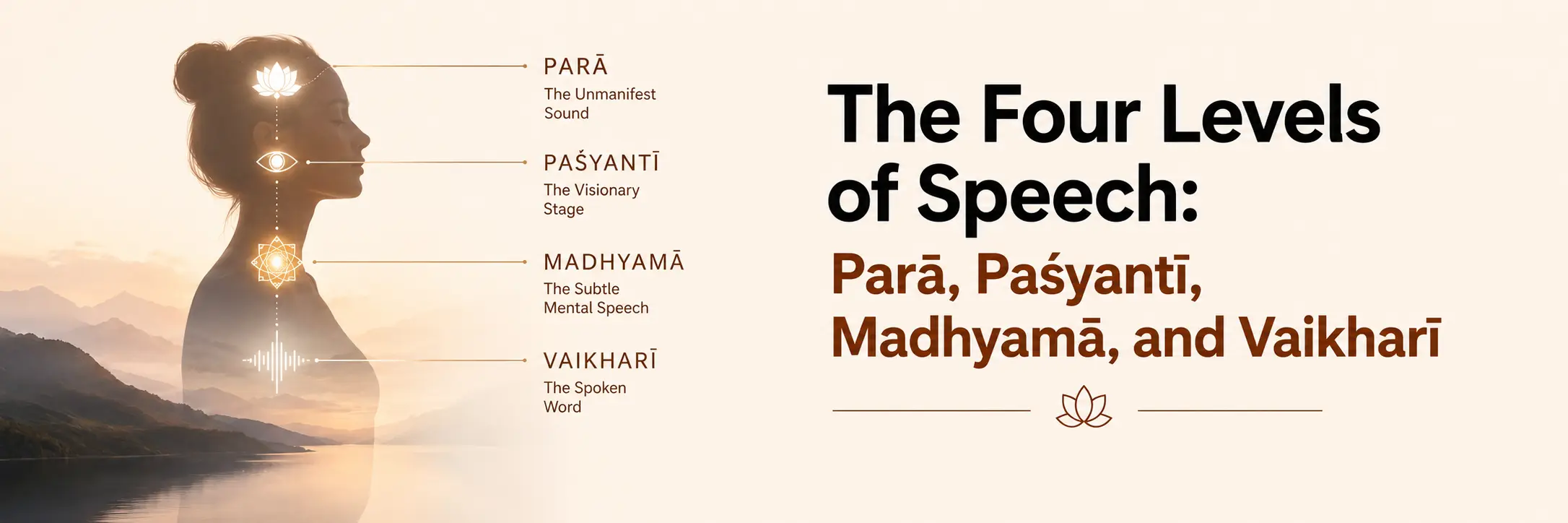
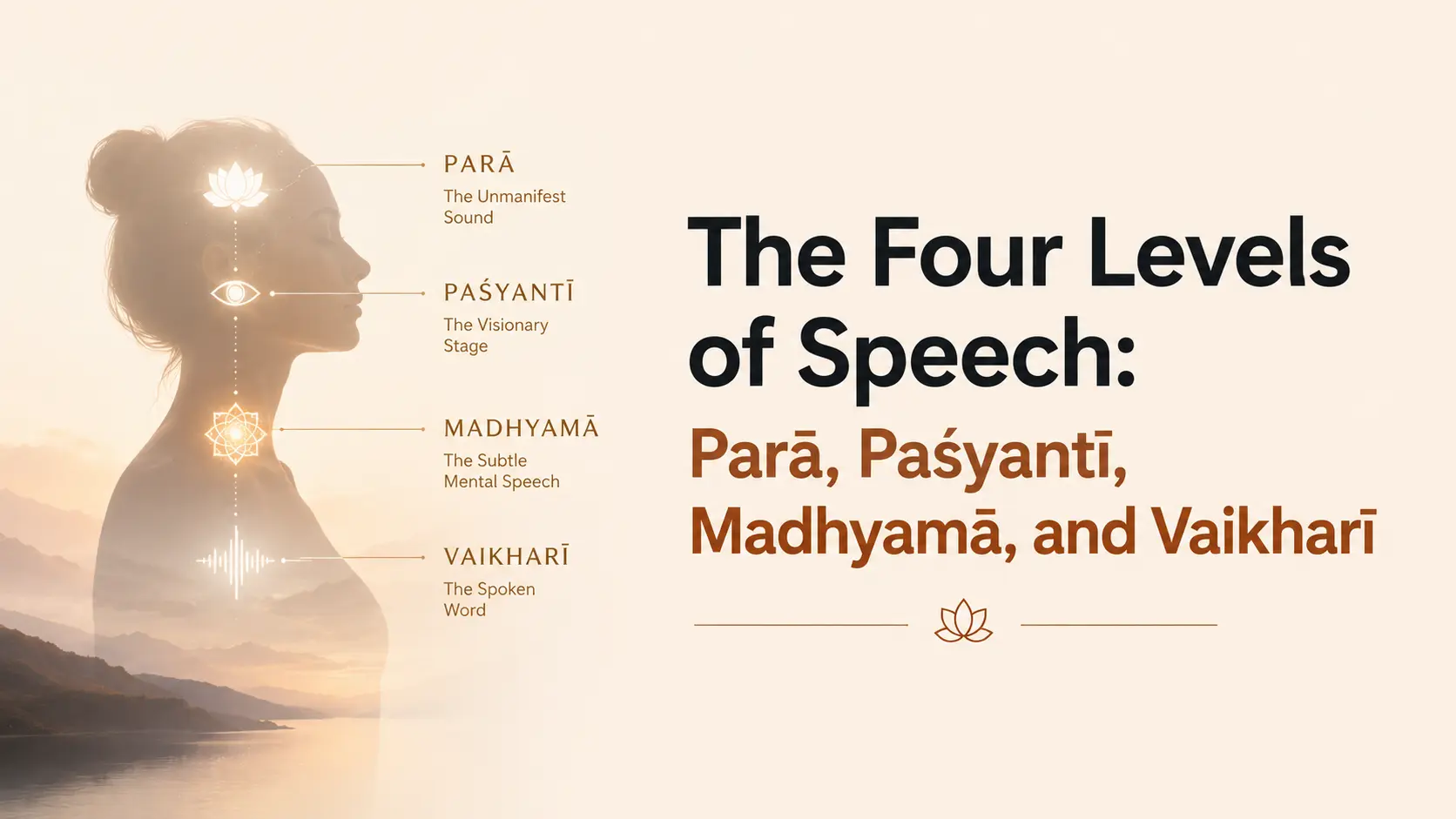
Parā — supreme speech
Paśyantī — seeing or visionary speech
Madhyamā — middle or mental speech
Vaikharī — articulated spoken speech
For serious mantra students and Trika practitioners, this teaching is essential. It shows that mantra is not only a sound we repeat. It is a movement of consciousness from silence into sound, and from sound back into silence.
The ancient Vedic tradition already hints at the mystery of fourfold speech:
A simple rendering is:
— Ṛgveda 1.164.45
This verse is profound. It says that the speech we ordinarily use is only the most external level. The deeper three remain hidden.
Tantra develops this insight into a complete spiritual psychology of sound.
Parā Vāk is the highest level of speech.
Here, speech has not yet become word, thought, image, or intention. It rests in pure undivided awareness. There is no separation between speaker, speech, meaning, and object.
Parā is speech as pure Shakti.
It is not silent because it lacks power. It is silent because all power is still gathered in undivided fullness.
At this level, mantra exists not as syllables, but as pure consciousness. The deity, mantra, meaning, and practitioner are not yet separate.
In Trika terms, Parā belongs to the supreme unity of Shiva and Shakti. It is the womb of all expression.
From Parā, speech begins to stir as Paśyantī.
The word Paśyantī comes from the root meaning “to see.” At this level, speech is not yet verbal. It appears as a direct seeing, a subtle inner vision, or a flash of meaning before words form.
You may have experienced this in ordinary life. Before you speak, you sometimes “know” what you want to say before the exact words appear. There is a whole meaning present, but not yet divided into grammar.
This is a faint reflection of Paśyantī.
For the mantra practitioner, Paśyantī is the level where mantra is seen inwardly as living meaning and light. The mantra is not merely heard; it is intuited.
Here, sound and meaning are still close to unity.
Madhyamā means the middle level.
This is mental speech — the level of thought, inner language, subtle repetition, silent dialogue, and conceptual formation.
Most people live strongly at this level without realizing it. The mind is constantly speaking inwardly. It comments, judges, remembers, imagines, worries, explains, and repeats old stories.
This is why mantra japa is so important. It purifies Madhyamā Vāk. Instead of allowing the mind to repeat unconscious impressions, mantra gives the mind a sacred current.
When mantra becomes mental, subtle, and steady, it begins to transform the inner language of the practitioner.
Vaikharī is the final and most external level of speech.
This is audible speech — the words spoken by the mouth, written by the hand, typed on a screen, chanted aloud, sung, whispered, or heard by others.
Vaikharī is powerful because it gives form to inner movement.
A word that remains inside is subtle. A word spoken aloud enters the shared field. It affects other minds, other hearts, and the atmosphere around us.
This is why speech must be handled carefully.
Gossip, harshness, falsehood, and careless words disturb Vaikharī and strengthen impurity in Madhyamā. Truthful speech, mantra, prayer, teaching, and silence refine Vaikharī and return it toward its source.
The spoken word is never isolated. It carries the vibration of the level from which it arose.
When mantra matures, the practitioner no longer experiences it merely as repetition. The mantra becomes a living current of Shakti returning to its source.
Sound returns to silence. | Speech returns to awareness. | The practitioner returns to Shiva.
The four levels of speech also explain creation.
The universe does not appear as dead matter. It appears as the vibration of consciousness. In Trika, manifestation is the expression of Shakti. Just as spoken words arise from inner meaning, the universe arises from the supreme Vāk of consciousness.
Parā is the undivided source.
Paśyantī is the first subtle vision of manifestation.
Madhyamā is the inner structuring of form and meaning.
Vaikharī is the fully expressed universe.
This is why mantra is not separate from creation. Mantra works because sound, meaning, consciousness, and manifestation are deeply connected.
The highest purpose of understanding the four levels is not to become fascinated with metaphysics.
A serious practitioner begins to notice where speech arises from. Is it arising from ego, fear, desire, and reaction? Or is it arising from clarity, compassion, truth, and awareness?
This transforms daily life.
Speech becomes slower, cleaner, more powerful, and more sacred.
Mantra becomes deeper.
Silence becomes alive.
Explore teachings on mantra, Vāk Shakti, silence, meditation, and Trika Tantra at Trika.in.