
Get a special discount for new members!

In Trika Tantra, bondage is not understood as a punishment.
It is not that the soul has become sinful, rejected, or separate from Shiva in any absolute way. The deepest Self is still consciousness. The light of awareness is still present. Shiva has not disappeared.
But consciousness becomes contracted.
The infinite begins to feel finite. The complete begins to feel incomplete. The free begins to feel bound. This contraction is explained through the teaching of the three malas.
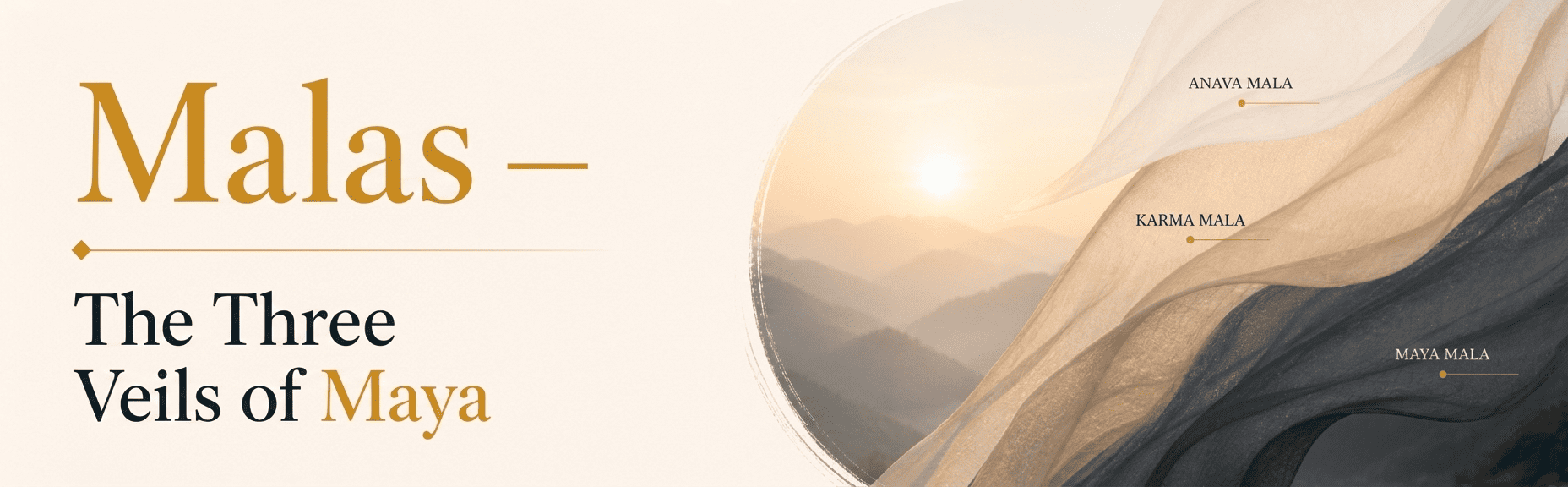
The word mala means impurity, covering, or limitation. In Kashmir Shaivism, mala does not mean moral dirt. It means a veil that conceals the natural fullness of consciousness. Traditional Kashmir Shaiva explanations describe the three malas as āṇava mala, māyīya mala, and kārma mala, the limiting conditions that restrict the free expression of consciousness.
These three malas are the reason the seeker feels, “I am small. I am separate. I am bound by my actions.”
They Do Not Destroy Consciousness. | They Only Cover Recognition.
The deepest mala is āṇava mala.
The word comes from aṇu, meaning the limited individual. Āṇava mala is the primal feeling of smallness. It is the contraction by which infinite consciousness experiences itself as incomplete.
This is the feeling:
The second mala is māyīya mala.
This is the impurity of difference. Because of māyīya mala, reality appears fragmented. We see “me” here and “the world” outside. We see others as separate. We see God as somewhere else. We see life as divided into sacred and ordinary, spiritual and worldly, pure and impure.
This mala affects perception.
It creates the sense of duality.
The world appears as many separate objects, and we forget the one consciousness in which all appears.
In daily life, māyīya mala becomes comparison, jealousy, fear of others, judgment, and the constant feeling that life is divided against itself.
The Trika path does not deny diversity. The world does appear as many forms. But māyīya mala makes us forget the unity behind diversity.
The flower, the breath, the body, the mantra, the Guru, the stranger, the sky, the emotion, the thought — all arise in one field of consciousness.
Māyīya mala makes the one appear as many without recognition.
Tantra restores the recognition of unity within multiplicity.
The third mala is kārma mala.
This is the limitation of action.
Because of kārma mala, the individual feels trapped in patterns. One acts from habit, desire, fear, memory, and unconscious conditioning. Then each action leaves an impression, and that impression pushes the person to repeat the same pattern again.
The seeker begins to feel:
“I am stuck” | “I always repeat this” | “I cannot act freely” | “I am bound by my past”
Kārma mala is connected with doership. The individual feels, “I am the separate doer, and I am bound by the fruits of my actions.” Traditional explanations describe kārma mala as the impurity connected with action and impressions of pleasure and pain.
This does not mean action itself is the problem.
In Trika Tantra, action is Shakti.
The problem is contracted action — action performed from ignorance, ego, compulsion, and separation.
When action is offered into awareness, it becomes sadhana.
When action arises from recognition, it becomes freedom.
The Shiva Sutras give a sharp teaching:
— Shiva Sutra 1.2
This helps us understand the malas.
Bondage is not that awareness is absent. Bondage is that awareness knows itself in a limited way.
Āṇava mala says: “I am small.”
Māyīya mala says: “I am separate.”
Kārma mala says: “I am bound by action.”
The path of Trika Tantra reverses this limited knowing.
Through sadhana, mantra, meditation, Guru’s grace, Shaktipat, self-inquiry, and recognition, the seeker begins to see differently.
“I am not merely small; my essence is consciousness.”
“I am not truly separate; all appears in one awareness.”
“I am not bound to unconscious action; Shakti can act through clarity.”
This is liberation beginning to unfold.
The malas are not dissolved by hatred of oneself.
They are dissolved by awareness, grace, and right practice.
Āṇava mala softens through direct recognition, surrender, and Shaktipat.
Māyīya mala softens through contemplation, meditation, mantra, and seeing unity in diversity.
Kārma mala softens through conscious action, discipline, purification of habits, and offering the fruits of action to the Divine.
This is why Tantra is not only philosophy.
It is practice.
The seeker must live differently, perceive differently, act differently, and return again and again to awareness.
The three malas are powerful, but they are not your true nature.
They are veils.
Āṇava mala creates smallness.
Māyīya mala creates separation.
Kārma mala creates bondage through action.
But beneath all three, awareness remains untouched.
The sun is not destroyed by clouds. It is only hidden.
In the same way, Shiva-consciousness is not destroyed by mala. It is only unrecognized.
The path of Trika Tantra is the sacred removal of forgetfulness.
As the veils become transparent, the seeker begins to recognize:
I was never merely small | I was never truly separate | I was never absolutely bound
The Self was always shining.
The path is to recognize it.
Explore teachings on the malas, Pratyabhijñā, meditation, mantra, Kundalini, Shaktipat, and Trika Tantra at Trika.in.