
Get a special discount for new members!
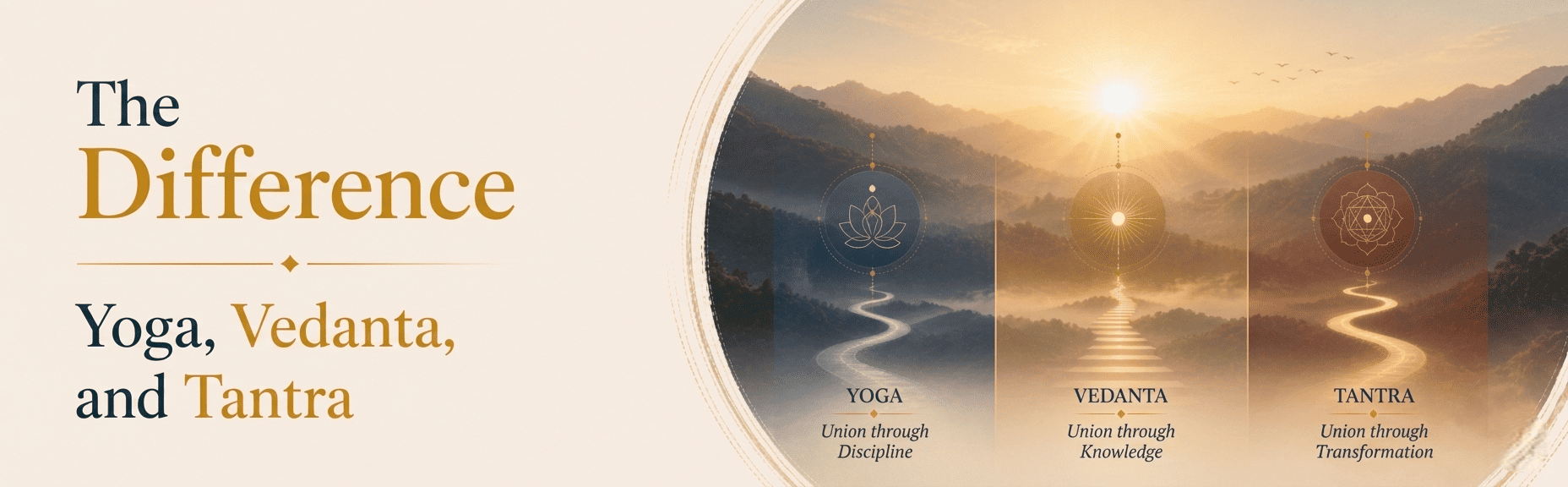
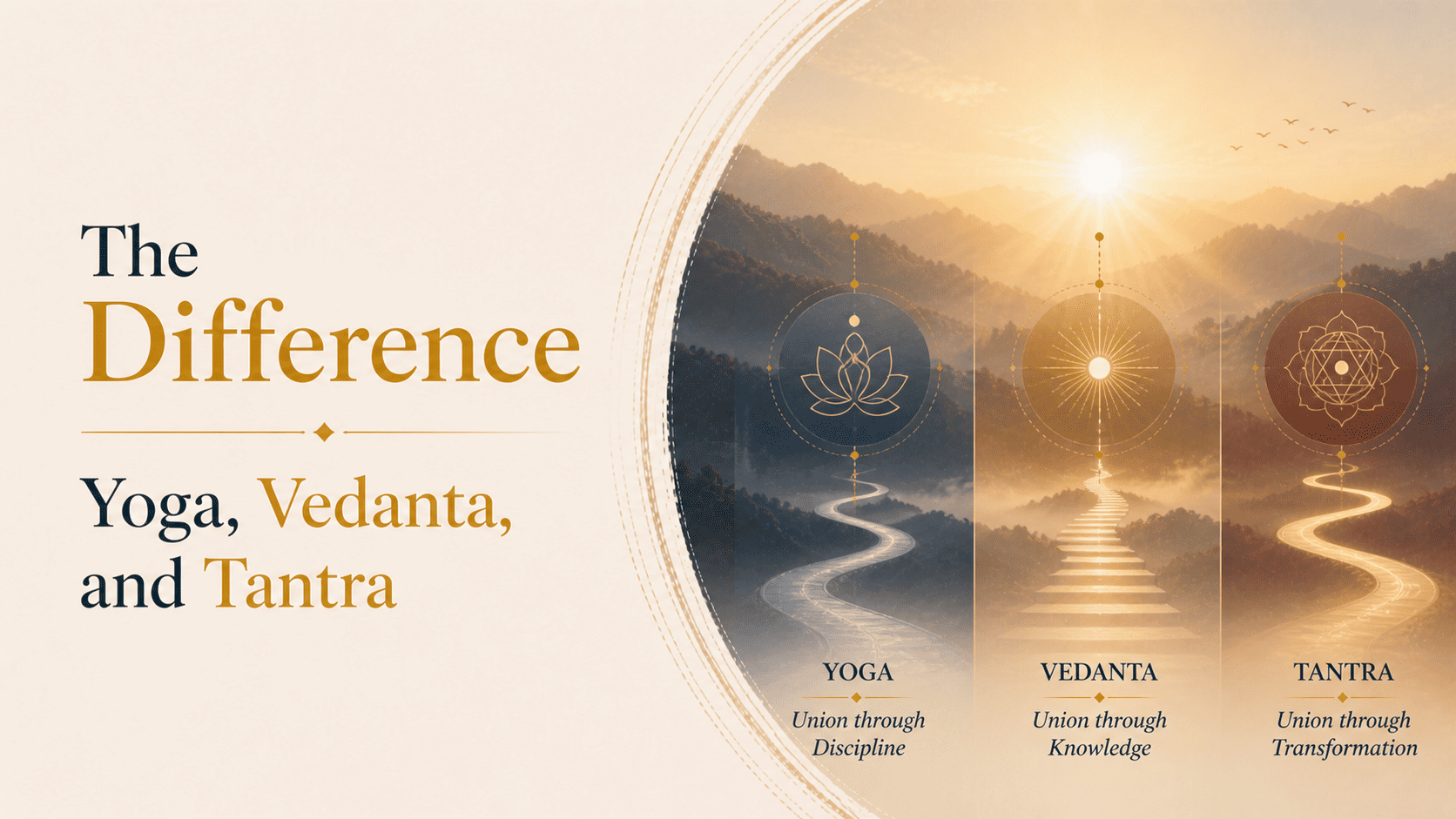
Many sincere seekers begin their journey with confusion.
They hear the word Yoga, and they think of postures, breathing, meditation, discipline, and stillness. They hear Vedanta, and they think of Self-knowledge, Brahman, nonduality, and inquiry. They hear Tantra, and the mind becomes even more confused. Some imagine ritual, mantra, Kundalini, deity worship, secrecy, or sexuality.
So a very natural question arises:
Are Yoga, Vedanta, and Tantra the same?
The answer is subtle.
They are not the same, but they are not enemies. They are different doorways into the sacred. Each has its own method, language, and spiritual psychology.
Yoga often begins with disciplining the mind. Vedanta often begins with knowing the Self. Tantra begins with recognizing that the whole of life — body, breath, mind, senses, energy, mantra, devotion, and the world — can become a field of awakening.
In the classical sense, Yoga is not merely exercise. It is a deep spiritual discipline for refining the body, breath, senses, and mind.
Patañjali defines Yoga very clearly:
The mind is full of movement: thoughts, memories, fears, desires, reactions, images, and impressions. These movements cover the clarity of the Seer. When they become quiet, the Seer rests in its own nature.
Yoga therefore gives the seeker discipline. Sit steadily. Breathe consciously. Restrain harmful impulses. Withdraw scattered attention. Concentrate the mind. Enter meditation.
This is a powerful path because most seekers are not ready for subtle truth until the mind becomes somewhat steady.
Yoga prepares the vessel.
But if Yoga is misunderstood, it can become harsh. A seeker may begin to fight the body, suppress emotion, or believe that every movement of the mind is an enemy. This is where Tantra brings another insight: movement itself is not outside consciousness.
Vedanta is the wisdom-stream of the Upanishads. Its central concern is the highest knowledge: the truth of the Self and the Absolute
Vedanta asks:
The great Upanishadic declaration “Tat tvam asi” — “That thou art” — appears in the Chandogya Upanishad as a teaching given to Śvetaketu, pointing him toward the subtle essence behind all existence.
Another famous declaration from the Bṛhadāraṇyaka Upanishad is:
This does not mean the ego is God. It means that when false identifications fall away, the deepest Self is not separate from the Absolute.
Vedanta is sharp and direct. It cuts through illusion. It says: you are not merely the body, not merely the mind, not merely emotion, memory, role, or story.
This is its greatness.
But if Vedanta is misunderstood, it can become too intellectual. A seeker may say, “I am Brahman,” while the body remains tense, the heart remains closed, and unconscious patterns still control daily life.
Truth must not remain only a sentence. It must become lived realization.
This is where Tantra becomes important.
Tantra does not begin by rejecting the body, senses, energy, emotion, or world.
Tantra begins with a bold vision:
Everything can become a doorway to awakening when held in awareness.
The body can become a doorway. The breath can become a doorway. Mantra can become a doorway. Desire, when refined, can become a doorway. Emotion, when illumined, can become a doorway. The world itself can become a doorway.
This does not mean indulgence.
Tantra does not say, “Do whatever you want.”
Tantra says, “Bring awareness, mantra, discipline, initiation, Shakti, and recognition into the whole field of life.”
The Vijñāna Bhairava Tantra gives a beautiful instruction:
“One should contemplate the whole body, or indeed the whole world, as consisting of consciousness. With the non-conceptual mind, supreme awakening arises.”
This verse beautifully expresses the Tantric approach.
Yoga may say: still the mind.
Vedanta may say: know the Self beyond body and mind.
Tantra says: recognize the body and the world themselves as expressions of consciousness.
The body is not the final Self, but it is not spiritually useless. The world is not to be blindly clung to, but it is not outside the Divine. Energy is not to be chased, but it is not to be rejected either.
In Trika Tantra, Shiva is consciousness and Shakti is the power of consciousness. The path is not to escape Shakti in order to reach Shiva, but to recognize Shakti as the living expression of Shiva.
A restless seeker may need Yoga because their life lacks discipline and steadiness.
An intellectual seeker may need Vedanta because they need discrimination and clarity.
An energetic, devotional, embodied seeker may be drawn to Tantra because their path opens through mantra, Shakti, meditation, Guru’s grace, and sacred participation in life.
But these paths can also support one another.
Yoga gives steadiness | Vedanta gives clarity | Tantra gives sacred embodiment
Yoga teaches the seeker not to be enslaved by the mind. Vedanta teaches the seeker that they are not limited to the mind. Tantra teaches the seeker to recognize even the movements of mind as Shakti appearing in awareness.
A mature practitioner does not need to insult one path to honor another. Each path has its own dignity.
The key is not confusion, but right understanding.
Yoga, Vedanta, and Tantra are three great streams of Indian spiritual wisdom.
Yoga says: become steady.
Vedanta says: know who you are.
Tantra says: recognize the Divine in the whole field of life.
Yoga refines the mind. Vedanta reveals the Self. Tantra consecrates body, breath, energy, mantra, and world as expressions of consciousness.
For a Trika practitioner, the integration can be very beautiful.
Be Disciplined Like a Yogi | Be clear like a Vedantin | Be alive, embodied, devotional, and awake like a Tantric practitioner
Let the mind become steady. Let the Self be known. Let Shakti be honored. Let life become sacred.
Then spirituality is no longer an escape from life.
It becomes the awakening of consciousness within life itself.
Explore authentic teachings on Trika Tantra, Kashmir Shaivism, meditation, mantra, Kundalini, Shaktipat, and the path of recognition at Trika.in.